


How China’s Pharmaceutical Innovation Is Moving Global Patients from “Drugs Available” to “Better Drugs to Choose From”
By:DengYue International Business Division
Against the backdrop of a profound restructuring of the global innovative drug value chain, China’s pharmaceutical industry is moving toward the center of the international stage at an unprecedented pace.
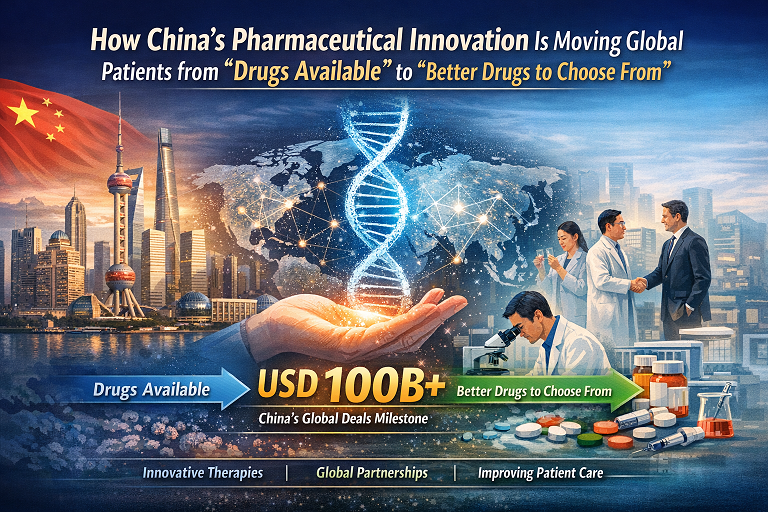
In 2025, the total value of China’s outbound innovative drug licensing (license-out) transactions officially surpassed USD 100 billion, marking a structural shift from a model centered on “technology import and absorption” to one characterized by global innovation supply.
According to data from global consulting firm SAI MedPartners, in the first half of 2025, China-related pharmaceutical business development (BD) transactions accounted for nearly half of total global deal value. Deng Xianpeng, President of SAI MedPartners Asia, noted that “by the end of 2025, China’s innovative drug BD transaction value is expected to exceed USD 100 billion.”
This projection has since been rapidly validated by market data.
According to the 2025 Q1–Q3 Pharmaceutical Transaction Trend Analysis released in October by a leading domestic industry data platform, China’s total license-out transaction value reached USD 92.03 billion in the first three quarters of 2025. When including the landmark collaboration between Innovent Biologics and Japan’s Takeda, announced in October, the cumulative total has formally exceeded USD 100 billion (approximately RMB 706.1 billion).
Disease Burden and Unmet Needs: Why AKT Has Returned to the Spotlight
From a disease epidemiology perspective, tumors closely associated with the AKT signaling pathway—including breast cancer, prostate cancer, ovarian cancer, and endometrial cancer—remain among the primary drivers of global cancer burden growth.
According to GLOBOCAN 2024, global annual new cancer cases have exceeded 20 million, with breast cancer ranking first worldwide for several consecutive years. In advanced and treatment-resistant stages, abnormal activation of the PI3K/AKT/mTOR pathway is widely recognized as a key mechanism underlying disease progression and therapeutic failure.
Despite substantial advances brought by targeted therapies and immunotherapies, significant unmet clinical needs persist in scenarios such as:
● Hormone receptor–positive breast cancer after endocrine therapy resistance
● Solid tumors following failure of multiple lines of treatment
● Patient populations limited by the toxicity profiles of PI3K inhibitors
Against this backdrop, the central question becomes: how to effectively suppress the pathway while maintaining safety and durable clinical benefit—a determining factor for whether AKT-targeted therapies can achieve true commercial viability.
Target Biology and Clinical Evidence: The Scientific Logic of AKT Inhibition
The AKT pathway serves as a central hub within the PI3K/AKT/mTOR signaling axis. Its three isoforms—AKT1, AKT2, and AKT3—play critical roles in:
● Tumor cell proliferation
● Cell survival
● Metabolic reprogramming
● Therapeutic resistance
Compared with earlier-generation PI3K inhibitors, next-generation AKT inhibitors focus on:
● More precise isoform selectivity
● Improved management of pathway-related toxicities such as rash and hyperglycemia
● Enhanced potential for combination with endocrine or chemotherapy regimens
Capivasertib, a compound that has achieved global regulatory breakthroughs, demonstrated in Phase III clinical trials:
● Significantly improved median progression-free survival (PFS) in patients with HR+/HER2− breast cancer
● Particularly pronounced efficacy in biomarker-selected populations
These results have directly prompted global pharmaceutical companies to reassess the commercial feasibility of the AKT target. In this context, next-generation AKT candidates developed by Chinese companies—if able to differentiate in efficacy window, safety profile, or dosing strategy—present a clear and rational case for global collaboration.
Market Opportunity and Commercial Potential: Why Multinational Pharma Is Willing to Bet
From a market perspective, AKT-related oncology therapeutics are transitioning from a phase of theoretical maturity to one of product realization.
Based on aggregated forecasts from multiple market research firms, including Wiseguy Reports and GlobalData:
● The global AKT-pathway drug market is expected to maintain mid-to-high single-digit to double-digit growthover the next 5–8 years
● Breast cancer remains the most commercially significant indication
● Combination regimens with CDK4/6 inhibitors and endocrine therapies are viewed as the most promising volume-driving scenarios
Notably, China has yet to establish a mature AKT-targeted treatment landscape, while globally only a limited number of products have entered late-stage development or commercialization. This imbalance—clear demand with constrained supply—forms the fundamental basis for high-value BD transactions.
Behind the USD 100 Billion Milestone: Three Landmark Deals Redefining China’s Global Expansion
The USD 100 billion figure is not an abstract milestone but the cumulative result of record-breaking transactions:
● May: 3SBio and its affiliates licensed the original drug SSGJ-707 to Pfizer.
The deal included USD 1.25 billion upfront, with up to USD 4.8 billion in development, regulatory, and sales milestones, plus tiered royalties—setting a new record for upfront payments in overseas licensing by a Chinese pharmaceutical company.
● July: Hengrui Medicine announced a strategic collaboration with GSK, granting global ex-China rights to the PDE3/4 inhibitor HRS-9821 and global option rights to up to 11 additional programs.
The deal included USD 500 million upfront, with total potential value reaching USD 12.5 billion.
● October (effective December): Innovent Biologics entered a global strategic partnership with Takeda, focusing on next-generation oncology immunotherapies and ADC platforms, with a total deal value of USD 11.4 billion.
A November Morgan Stanley report identified this as the largest outbound oncology licensing deal by a Chinese pharmaceutical company in terms of total transaction value.
Within six months, three outbound licensing records were successively broken—sending a clear signal: China’s innovative drugs are increasingly becoming a core source of global pharmaceutical supply.
From Single-Asset Deals to System-Level Collaboration
From a commercial standpoint, BD is evolving from isolated product licensing toward a tool for global R&D ecosystem integration.
According to Liang Kunyan, healthcare analyst at LeadLeo Research Institute, the key drivers include:
● On one hand, multinational pharmaceutical companies face an accelerating patent cliff. Fangzheng Securities estimates that by 2030, blockbuster drugs with annual sales of approximately USD 200 billion will lose exclusivity.
● On the other hand, after years of R&D accumulation, Chinese pharmaceutical companies have formed a pool of high-quality, internationally translatable, and globally verifiable clinical assets.
Structurally, oncology and immunology remain the core transaction areas. ADCs and bispecific antibodies have seen sustained growth in deal value since 2023; metabolic and obesity therapies—centered on GLP-1 and multi-target metabolic modulators—entered an explosive collaboration phase in 2025. Licensing activity is also rising across autoimmune diseases, rare diseases, and select CNS indications.
Corporate Profiles and Collaboration Logic: R&D Depth × Global Capability
Such collaborations typically reflect a clear division of roles. One party is a China-based, R&D-driven biotech, characterized by:
● Strong early-stage molecular design and translational capabilities
● Efficiency advantages in domestic clinical advancement
● Long-term target-focused technological accumulation
The other is a multinational pharmaceutical company with irreplaceable strengths in:
● Global multicenter clinical trials
● Regulatory submissions worldwide
● Market access and commercial infrastructure
At its core, this collaboration model represents risk-sharing and value amplification—and exemplifies the rational globalization of China’s innovative drug sector.
Industry and Policy Perspective: The Outcome of a Decade of Systemic Reform
Looking back over the past decade, China’s pharmaceutical industry has undergone a series of coordinated institutional transformations:
● 2015: Launch of comprehensive drug review and approval reform
● 2018: Introduction of the implied approval system for clinical trial applications
● 2020: Implementation of the Breakthrough Therapy designation
● 2021: Dual-channel reimbursement policy improving access to innovative drugs
● 2022: Accelerated review procedures for innovative drug marketing applications, emphasizing clinical value
● 2025: Release of Several Measures to Support the High-Quality Development of Innovative Drugs, forming end-to-end policy support
Rather than relying on isolated policy stimuli, China has achieved systemic reconstruction across R&D initiation, clinical validation, regulatory review, reimbursement, and commercialization through continuous, incremental, and directionally consistent reforms.
As summarized by Liang Jialin of the China Health Insurance Research Association, the industry has progressed from generic dominance, to innovation activation, and now toward quality- and global value–oriented development, entering a new cycle of participation in global innovation and value creation.
Conclusion
The renewed momentum around the AKT target reflects a broader transformation within China’s innovative drug industry. The focus is no longer on simply “keeping pace with global trends,” but on identifying clinically and commercially meaningful breakthroughs within mature yet under-addressed pathways.
What these collaborations represent is not aggressive expansion, but rational positioning and growing confidence within the global innovation system.
In this process, China pharmaceutical export enterprises such as DengYueMed are increasingly serving as critical connectors within the global pharmaceutical value chain. Anchored in long-term commitments to quality, compliance, and integrity, and guided by principles of excellence, innovation, sustainability, and social responsibility, these companies are enabling Chinese innovation to reach international markets more efficiently—while delivering tangible improvements in global patient access and therapeutic choice.
As global healthcare moves from “drugs available” toward “better drugs to choose from,” China’s innovative medicines are becoming an increasingly significant source of supply—and China’s internationally oriented pharmaceutical export enterprises stand at a pivotal point in shaping this transition.
References
1. GLOBOCAN 2024. Global Cancer Statistics.
2. Nature Medicine. Targeting the PI3K–AKT pathway in cancer.
3. The New England Journal of Medicine. Capivasertib in Hormone Receptor–Positive Advanced Breast Cancer.
4. Wiseguy Reports. Global AKT Inhibitor Market Forecast.

 English
 Arabic
 French
 Spanish
 Deutsch
 Turkish
 Dutch
Dutch
 Italiano
 Russian
 Romaian
 Portuguese (Brazil)
 Greek
Greek